The Calculus of Mortality

CW: talk of mortality, partner illness, potential loss, mental health
This piece is a bit of a departure from my first tech content posts. One of my goals for this blog is to create a space to discuss the realities of real life. You can't design inclusive technology without acknowledging and sharing the vastness of human experience. So here is the first post about my own very human experience.
I care about your well-being, and I would like for you to take the content warning above this post seriously. It discusses the possibility of death, my own mental health, and medical circumstances. If you are ok with that, please read on.
For over three years, I watched my partner's health slowly deteriorate. We faced the challenges of diagnosis, acceptance, and, ultimately, a life-saving liver transplant. During this time, I grappled with the stark contrast between his mortality and our family's survival.
In respect of my partner’s privacy, the details of his illness are his to share. What I have to share are, as a partner, a mother, and just me, the steps I took to cope with, prepare, and create consistency for us as a family during that time.
I want to start with something raw and real. What follows is a piece I wrote about that challenging time, capturing both the fear and strength as they coexisted. My hope is that by sharing this, those of you facing similar struggles might find some comfort in knowing you're not alone. For those who watched us going through it in real-time, thank you for being there.
Thank you for reading.
Warmly, Jessica
When my partner was really sick, I started to do this self-check, this math with myself: what would I do if he died today?
It would take the breath out of me momentarily, but emotion was a distraction.
I needed a checklist. What to do if it happened. As though I was going grocery shopping.
- Do we have enough food? Buy more of the essentials.
- I’d rather not have dishes in the sink when I’m dealing with that, let’s get those done.
- The garbage and recycling, too.
- Does Nina have to be picked up/watched?
- How will she be sheltered from the horror?
- Is she safe? The school has everyone on the list cleared for pickup.
- My brother. Dad. Mom. My Aunt. My Uncle...
- Who do I have to call?
- Who is in a 30-minute radius?
- Do I have comfortable clothes?
- I should shower. I may not shower for quite a while if he dies.
- I’m not going to tell anyone yet.
- The list is long. Set up a
phonetext tree. - When do I call his mom?
- Before or after my parents and brother?
- I need them to watch Nina. I need them to care for me.
- Call his mom after your family.
- After them is ok.
Do it when you can breathe, and when you can cry along with her.
Hearing his mother will break you.
Get everything done before that.
Even now, when I can hear his healthy and strong footsteps walking around the house, this checklist braces my heart like an imminent car-crash. The tears start to fall. I am gutted again. Insides cantaloupe-scooped out.
I lived entirely by checklists at the time. What to do for any given hypothetical. Mental go-bags alongside the real ones packed for all three of us. What to do if we got a call for a viable donor organ. What to do if, instead, we never did.
Keeping track of work. Keeping track of home. A constant shifting up and down of priorities.
Let me tell you: my little anxiety-laden Product Manager brain trained a lifetime for this moment!
MVP. Most Viable Person.
What do I have to do to make myself my most viable person today?
Checklist. Nina is safe. He is safe. Ok, we can go on to the next set of priorities a level down.
Some people call this living in survival mode. Ok. Sure. But I’ll be honest, while I can see the obviousness of that now, at the time it was just how I lived. I was fine. Fine. Everything was fine. Fine. Fine. I was breathing. The air was fresh.
There were happy moments that punctured through: a trip to California, finding that place with the heated outdoor pool so we could swim in a snowfall under the night sky, Nina's pre-K graduation.
I could look around and see the stability of a community around me ready to jump into action. I felt more than fine. I felt loved and rich for it.
Crisis reaffirmed the depth and bonds of my community.
That was my honest truth. I’d be able to land on my feet. I was doing the math to make sure I would. I had people around me to help lift me if I needed it. I was blessed, really. Lucky, even, when looked through the right lens.
- Groceries. Check.
- Pick up Nina. Check.
- Write that memo for the Trustee’s meeting. Check.
- Did you eat? Eh, we can push that until later.
- Did you have water? Um. You have to have water. Ok. Yes. …check.
- Do that 1:1. Check.
- Transplant education. Check.
- Review those project requests. Check.
- Make sure Nina eats. Check.
I would run through the checklists as I walked down the street.
- What if we had another ER situation today?
- What if we got the donor call today?
- What if he died today?
- Which checklist needs invoking?
When you are in a relationship, sometimes you do the mortality calculus of “I hope that person dies before me so that I don’t have to be without them.” What if the calculus changes and you realize, “oh wait, he might really die before me. I may really have to be without him.”
The checklists felt practical. They mainly focused on the carrying on of household stuff and making sure that my daughter was ok, that her emotional landscape was supported.
I wouldn’t dare do the emotional checklist of how would I get on. You know, if… That felt like betrayal. That felt like taking hope away. My mind would drift there of course, and I’d snap it back. Look at him. “He’ll be ok. We’ll get through this. We’ll get through this. There is something else beyond this and we’ll be stronger for it.” Hope would momentarily quiet the checklists.
The checklists were my shield against the unthinkable. They helped me carve out my life into the smallest manageable proportions.
This was how I maintained everything for those years.
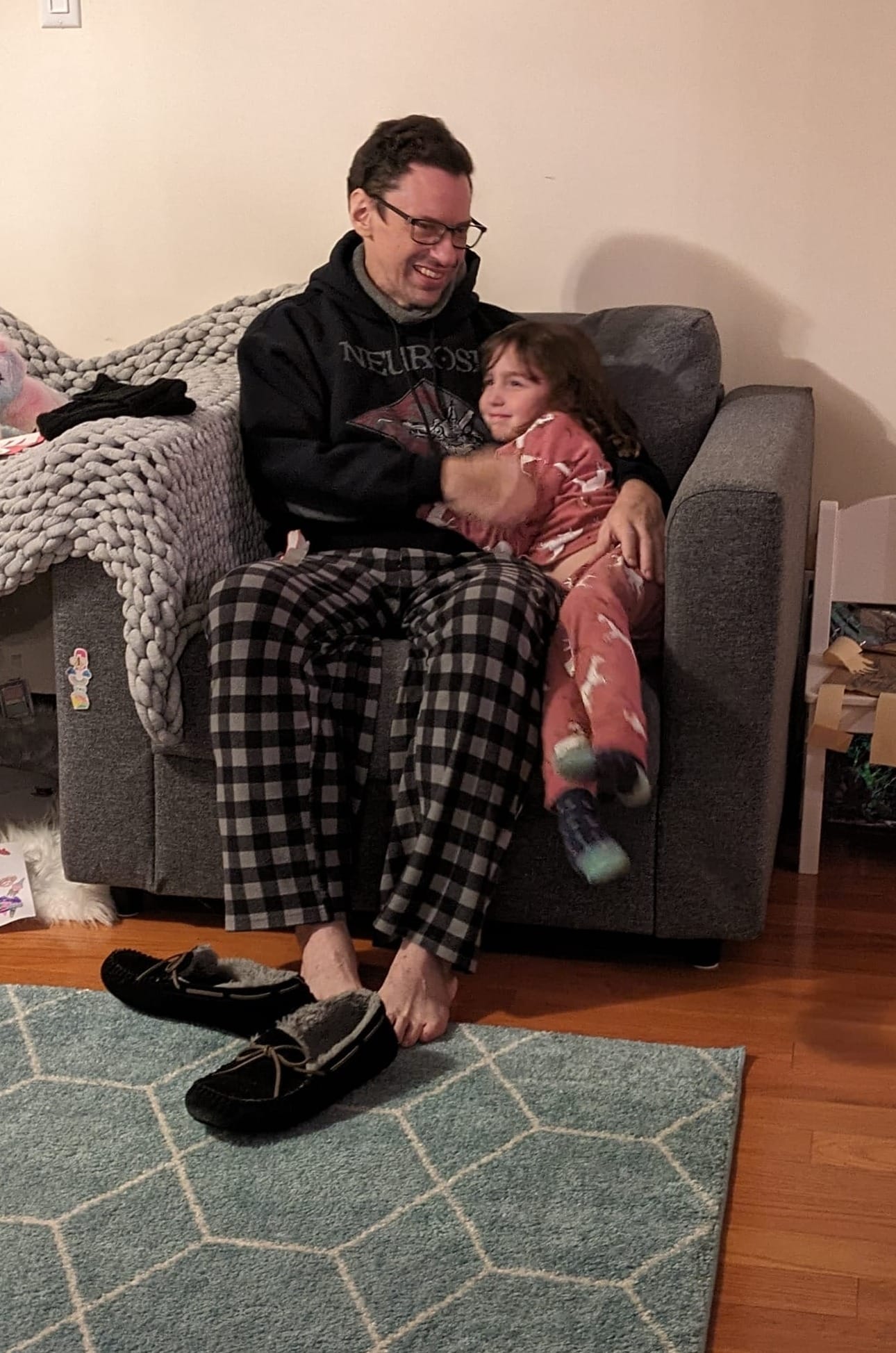
The night he came home from the hospital, after the successful transplant, we decided to surprise my daughter. She knew he would be coming home soon, and she had made a welcome home package for him, tucked away for safekeeping until he was actually physically home.
There’s this picture from that night. It’s the background of my phone. They’re sitting together on a chair, both in their pajamas. It's a bit blurry as they sink into a hug, smiling, laughing, and so relieved.
That was the moment. The exact moment the checklists went away. Their smiles, their awkward squished tangling into each other’s arms, let me finally exhale.
We are about to cross the 1-year mark of that life-saving surgery. I still have checklists, of course (my brain is still my brain). These days, my checklists have transformed into invitations to savor the moment, to fully immerse myself in the emotions rather than sidestep them.
- Be present.
- Notice the light coming through the trees.
- Listen to his and Nina’s laughter mixing as they play in the kitchen.
- Feel his arms around you when you hug. Really feel him.
- Memorize the feeling of Nina cuddling up next to you.
- Tell him you love him. Not out of fear, but out of joy.
- Drink water.
- Breathe.
If you're caught in the thick of it now, know this: Your checklists might evolve too. For now, just breathe. Notice the air filling your lungs. Feel your feet on the ground.
You are here. You are present. You are doing this.
Check, check, and check.
[Post Image Prompt: A dreamlike, abstract illustration of two intertwined trees. One tree is lush with vibrant green leaves, while the other has fewer leaves in warm autumn colors. As leaves fall from the autumn tree, they transform into translucent sheets with faint checklist markings. A small, bright sapling grows between the trees. The background features soft, calming hues of blue and purple, fading into a warm, hopeful glow on the horizon. Subtle, ghostlike silhouettes of a family embrace near the trees. The overall style should be impressionistic and emotive, conveying resilience, love, and renewal without being overly literal.]